Wi-Fi has changed dramatically over the last three decades. What started as a simple wireless networking technology capable of transferring data at just 2 Mbps has evolved into a high-speed standard that can deliver speeds of over 23 Gbps. Every new Wi-Fi generation has improved speed, coverage, capacity, security, and the ability to connect more devices at the same time.
Whether you’re buying a new router, upgrading your home network, or simply curious about the latest Wi-Fi standards, understanding how Wi-Fi has evolved makes it easier to choose the right technology.
What Does Wi-Fi Stand For?
Despite what many people believe, Wi-Fi does not officially stand for “Wireless Fidelity.” The term Wi-Fi is simply a brand name created by the Wi-Fi Alliance when wireless networking technology became commercially available. It was chosen because it was short, easy to remember, and sounded similar to the well-known term Hi-Fi (High Fidelity) used in audio equipment. Although “Wireless Fidelity” became a popular explanation over the years, the Wi-Fi Alliance has confirmed that Wi-Fi is not an acronym and has no official full form. Today, Wi-Fi refers to the wireless networking technology that allows devices like smartphones, laptops, tablets, smart TVs, and IoT devices to connect to the internet and communicate without using physical cables.
Wireless Fidelity Definition
Wireless Fidelity is a phrase that was widely used as an unofficial expansion of the term Wi-Fi, but it is not the official meaning of Wi-Fi. Many people assumed that Wi-Fi stood for Wireless Fidelity because it sounded similar to Hi-Fi (High Fidelity), a term used for high-quality audio systems. However, the Wi-Fi Alliance has clarified that Wi-Fi is simply a brand name and not an acronym. Today, the term Wi-Fi refers to the family of wireless networking standards (IEEE 802.11) that enable devices to connect to a network and the internet without physical cables.
Meaning of “Fidelity” in Wi-Fi
The word fidelity means faithfulness, accuracy, or the ability to reproduce something without losing quality. In technology, it describes how accurately a signal or piece of information is transmitted or reproduced. For example, High Fidelity (Hi-Fi) audio systems are designed to reproduce sound as closely as possible to the original recording. Although the phrase Wireless Fidelity suggests reliable and accurate wireless communication, the word “fidelity” is not officially part of the Wi-Fi name. It became associated with Wi-Fi simply because of its similarity to the familiar term Hi-Fi, not because it describes the technology’s official meaning.
How Wi-Fi Works
Wi-Fi works by using radio waves to transmit data between your device and a wireless router. When you connect a smartphone, laptop, or tablet to a Wi-Fi network, the router receives internet data from your broadband connection and converts it into radio signals. Your device has a built-in wireless adapter that receives these signals, converts them back into digital data, and displays the requested content, such as websites, videos, or emails. The communication happens in both directions almost instantly, allowing you to browse the internet, stream videos, make video calls, and transfer files without using physical network cables. Modern Wi-Fi networks operate on the 2.4 GHz, 5 GHz, and 6 GHz frequency bands, providing faster speeds, lower interference, and better performance for multiple connected devices.
What Are Wi-Fi Generations?
Wi-Fi generations refer to different versions of the IEEE 802.11 wireless networking standards. Earlier versions were identified only by technical names like 802.11n or 802.11ac, which often confused users.
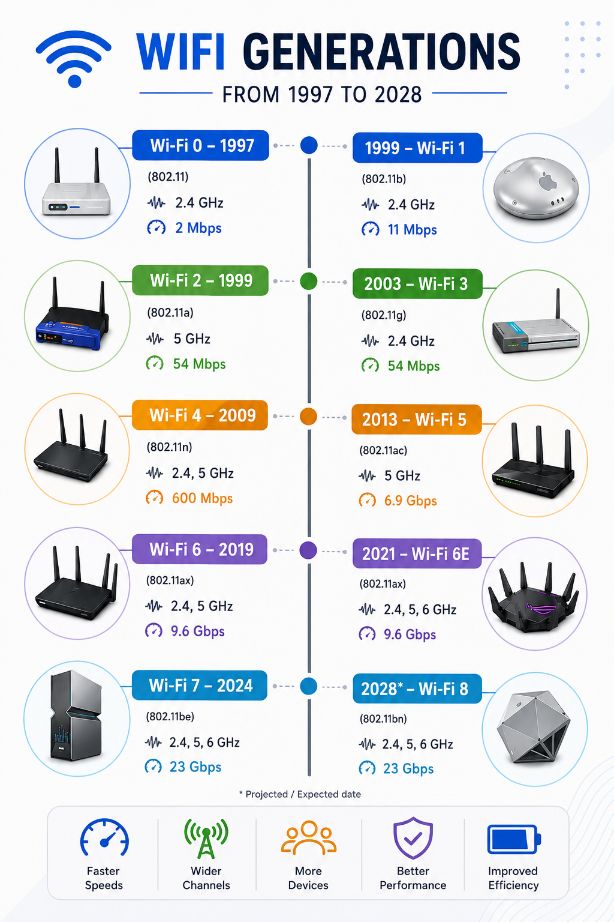
To simplify things, the Wi-Fi Alliance introduced easy-to-understand names:
- Wi-Fi 4
- Wi-Fi 5
- Wi-Fi 6
- Wi-Fi 6E
- Wi-Fi 7
- Wi-Fi 8 (upcoming)
These names make it much easier to compare routers, laptops, smartphones, and other wireless devices.
Wi-Fi 0 (1997)
Standard: 802.11
The first Wi-Fi standard was introduced in 1997. It operated on the 2.4 GHz frequency band and offered a maximum speed of just 2 Mbps.
At the time, this was enough for simple file sharing and basic internet access. However, today’s websites, videos, and cloud services would be impossible to use comfortably with this speed.
Key Features
- 2.4 GHz frequency
- Up to 2 Mbps
- First wireless networking standard
- Very limited range and speed
Wi-Fi 1 (1999)
Standard: 802.11b
Wi-Fi 1 increased the maximum speed to 11 Mbps while continuing to use the 2.4 GHz band.
This version became widely popular because it made wireless internet practical for homes and offices.
Improvements
- Faster browsing
- Better wireless coverage
- Affordable hardware
- Widespread adoption
Wi-Fi 2 (1999)
Standard: 802.11a
Released around the same time as Wi-Fi 1, Wi-Fi 2 introduced the 5 GHz frequency band.
Although it offered much faster speeds of 54 Mbps, the shorter range and higher equipment costs slowed its adoption.
Benefits
- Less wireless interference
- Higher bandwidth
- Better performance in crowded environments
Wi-Fi 3 (2003)
Standard: 802.11g
Wi-Fi 3 combined the advantages of previous generations by providing 54 Mbps speeds while operating on the 2.4 GHz band.
It quickly became one of the most widely used Wi-Fi standards worldwide.
Advantages
- Good balance of speed and range
- Compatible with older Wi-Fi devices
- Lower hardware costs
Wi-Fi 4 (2009)
Standard: 802.11n
Wi-Fi 4 represented one of the biggest improvements in wireless networking. It introduced support for both 2.4 GHz and 5 GHz frequencies and increased speeds up to 600 Mbps.
This generation also introduced technologies like MIMO (Multiple Input Multiple Output), allowing multiple antennas to send and receive data simultaneously.
Major Improvements
- Dual-band support
- Faster downloads
- Better streaming quality
- Improved signal strength
- More reliable connections
Wi-Fi 5 (2013)
Standard: 802.11ac
Wi-Fi 5 focused on delivering much higher speeds using the 5 GHz band. With theoretical speeds reaching 6.9 Gbps, it became the preferred choice for modern homes and businesses.
It greatly improved HD and 4K video streaming, online gaming, and large file transfers.
Key Features
- Up to 6.9 Gbps
- Wider wireless channels
- Beamforming technology
- Better support for multiple connected devices
Wi-Fi 6 (2019)
Standard: 802.11ax
Wi-Fi 6 was designed for today’s connected world, where homes often have dozens of smart devices connected at the same time.
Instead of focusing only on higher speeds, Wi-Fi 6 also improved network efficiency and reduced congestion.
Specifications
- 2.4 GHz and 5 GHz
- Up to 9.6 Gbps
- Better battery life for mobile devices
- Lower latency
- Improved performance in crowded networks
Wi-Fi 6 is ideal for smart homes, video conferencing, cloud gaming, and busy office environments.
Wi-Fi 6E (2021)
Standard: 802.11ax with 6 GHz support
Wi-Fi 6E expanded Wi-Fi 6 by adding access to the new 6 GHz frequency band.
This new spectrum provides additional wireless channels, helping reduce interference and improve performance in dense environments like apartments and office buildings.
Benefits
- 2.4 GHz, 5 GHz, and 6 GHz support
- Less congestion
- Faster wireless connections
- Lower latency
- Better support for VR and AR applications
Although the maximum speed remains 9.6 Gbps, real-world performance often improves because of the cleaner wireless spectrum.
Wi-Fi 7 (2024)
Standard: 802.11be
Wi-Fi 7 is the latest commercial wireless standard and represents another major leap forward.
It supports all three frequency bands—2.4 GHz, 5 GHz, and 6 GHz—with theoretical speeds reaching 23 Gbps.
New technologies like Multi-Link Operation (MLO) allow devices to transmit data across multiple frequency bands simultaneously, resulting in lower latency and more stable connections.
Key Advantages
- Up to 23 Gbps
- Extremely low latency
- Faster cloud gaming
- Better 8K video streaming
- Improved support for AI workloads
- Enhanced performance for smart homes
Wi-Fi 8 (Expected Around 2028)
Wi-Fi 8 is still under development and is expected to focus less on increasing maximum speeds and more on improving overall reliability.
While early expectations suggest speeds around 23 Gbps, the main goal is expected to be consistent performance in environments with many connected devices.
Possible improvements include:
- Better roaming between access points
- Lower latency
- Improved reliability
- Higher efficiency
- More stable connections for enterprise and industrial applications
Since development is ongoing, the final specifications may change before release.
Wi-Fi Generation Comparison
| Generation | Standard | Frequency | Maximum Speed |
|---|---|---|---|
| Wi-Fi 0 | 802.11 | 2.4 GHz | 2 Mbps |
| Wi-Fi 1 | 802.11b | 2.4 GHz | 11 Mbps |
| Wi-Fi 2 | 802.11a | 5 GHz | 54 Mbps |
| Wi-Fi 3 | 802.11g | 2.4 GHz | 54 Mbps |
| Wi-Fi 4 | 802.11n | 2.4 & 5 GHz | 600 Mbps |
| Wi-Fi 5 | 802.11ac | 5 GHz | 6.9 Gbps |
| Wi-Fi 6 | 802.11ax | 2.4 & 5 GHz | 9.6 Gbps |
| Wi-Fi 6E | 802.11ax | 2.4, 5 & 6 GHz | 9.6 Gbps |
| Wi-Fi 7 | 802.11be | 2.4, 5 & 6 GHz | 23 Gbps |
| Wi-Fi 8* | Expected | 2.4, 5 & 6 GHz | Around 23 Gbps* |
*Expected specifications are based on current industry development and may change.
Why Each New Wi-Fi Generation Matters
Every new generation improves more than just speed. Modern Wi-Fi standards are designed to handle today’s internet usage, where multiple users stream videos, attend online meetings, play games, and connect smart devices at the same time.
The biggest improvements over the years include:
- Faster wireless speeds
- Wider wireless channels
- Better coverage
- Lower latency
- Support for more connected devices
- Improved battery efficiency for mobile devices
- Stronger security features
- Better overall network performance
Which Wi-Fi Generation Should You Choose?
For most households today, Wi-Fi 6 or Wi-Fi 6E offers an excellent balance of performance, coverage, and future compatibility. If you’re buying new premium networking equipment or have very high-speed internet, Wi-Fi 7 provides the best performance and is built for next-generation applications.
Older standards like Wi-Fi 4 and Wi-Fi 5 are still suitable for basic web browsing and streaming, but they may struggle in homes with many connected devices.
Final Thoughts
The evolution of Wi-Fi shows how wireless networking has adapted to changing technology and user demands. From 2 Mbps in 1997 to 23 Gbps with Wi-Fi 7, each generation has delivered meaningful improvements in speed, efficiency, and reliability.
As internet usage continues to grow and more devices become connected, future Wi-Fi standards will focus not only on faster speeds but also on creating more stable, intelligent, and efficient wireless networks for homes, businesses, and emerging technologies.
Suggestions
- Windows DiskPart Commands Explained
- Which Operating System Should You Choose?
- Error Code 0x0000001A Explained
- What Is Cache Memory?
- Must-Know Windows Repair Commands Every User Should Learn
- 10 Ways to Protect Your Digital Footprint
- What Is a Digital Footprint?
- What Happens When Your C Drive Is Full?
- Windows 11 July 14 Patch Tuesday Update